Someone just thanked you over text, and you fired back “yw” without even thinking about it. Or maybe you got a “yw” from a friend, coworker, or that guy you’re dating, and something about it felt… off. Was it warm? Was it dismissive? Did they even care?
Texting slang moves fast, and YW is one of those tiny abbreviations that carries a surprising amount of weight depending on who sends it and how.
If you’ve ever paused mid-conversation wondering what does YW mean after thank you, you’re not alone — it’s one of the most searched texting abbreviations out there. This guide breaks down exactly what YW means, why people use it, when it’s totally fine, and when you might want to reach for something else instead.
Quick Answer
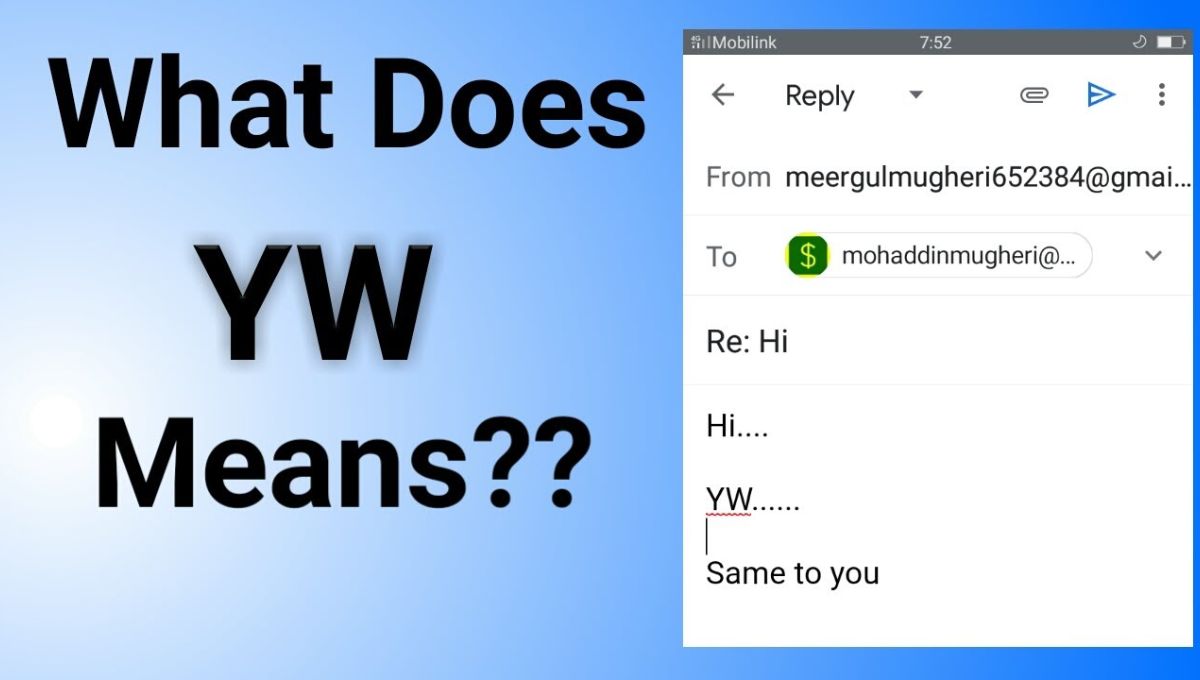
YW stands for “You’re Welcome.” It’s the short, casual reply people send after someone says “thank you” over text, in a chat app, or on social media.
That’s the simple part. The trickier part? Tone. A plain “yw” can read as friendly and quick — or flat and a little cold — depending on the context, the punctuation, and honestly, who’s sending it. We’ll get into all of that below.
What Does YW Mean After Thank You?

Full Form of YW
YW is a texting abbreviation that stands for “You’re Welcome.” It follows the same shorthand logic as other clipped texting phrases like “np” (no problem) or “ty” (thank you) — take a common phrase, trim it down to its first letters, and save yourself a few keystrokes.
Plain-English Explanation
Here’s the deal in the simplest terms possible: when someone thanks you for something, YW is your quick way of acknowledging it without typing out the whole phrase. Think of it as a verbal nod packed into two letters. You didn’t ignore them, you didn’t overthink it, you just replied.
So if a friend texts “thanks for covering my shift!” and you reply “yw,” you’re saying “you’re welcome” in the fastest, most efficient way texting allows. Nothing more complicated than that — though, as you’ll see, how you send it can shift the meaning quite a bit.
Why People Use YW
People reach for YW mostly because texting rewards speed. Nobody wants to type out full sentences for every tiny exchange, and honestly, most “thank you” and “you’re welcome” swaps don’t need much more than a quick acknowledgment anyway.
A few reasons YW has stuck around as a go-to reply:
- It’s fast. Two letters beat eleven every time.
- It fits the rhythm of texting. Conversations move quickly, and long replies can actually feel like they’re slowing things down.
- It works almost everywhere. Friends, family, coworkers, group chats — YW slides into nearly any casual conversation without friction.
- It matches how we already talk. Even in person, plenty of people say “yeah, no problem” instead of a formal “you’re welcome.” YW is just the texting version of that same casual energy.
Short Example Sentence
Text A:
“Thanks for helping me move that couch!” Text B: “yw, anytime 😊”
Simple, quick, and the emoji does a lot of heavy lifting here — it turns a flat two-letter reply into something that feels genuinely warm.
Where Is YW Commonly Used?
Common Places You’ll See YW
YW pops up just about anywhere casual conversation happens over text or online:
- Text messages between friends and family
- Group chats (this is where YW shows up constantly, often paired with emojis or GIFs)
- Social media comments, especially replies to compliments or shoutouts
- Direct messages on platforms like Instagram, Snapchat, or Discord
- Casual workplace chats, like a quick Slack or Teams message between coworkers who know each other well
Tone of YW
Tone is really where YW gets interesting. On its own, plain lowercase “yw” with no punctuation can come across as pretty neutral — sometimes even a little short or dismissive, especially if the other person put real effort into their thank-you.
Add a little flair, though, and the tone shifts completely:
| Version | Tone |
| yw | Neutral, sometimes flat |
| Yw! | Friendly, upbeat |
| yw 🙂 | Warm, casual |
| yw, anytime! | Genuinely welcoming |
| YW | Can read as shouting or abrupt in some contexts |
Realistic Conversation Examples (Text Style)
Friend group chat:
A: “omg thank you for remembering my birthday 🥹” B: “yw!! of course I remembered lol”
Sibling text:
A: “thanks for picking up milk” B: “yw”
Coworker Slack message:
A: “Thanks for covering that meeting for me today, really appreciate it” B: “yw, no worries at all!”
Dating app conversation:
A: “Thank you for such a sweet compliment” B: “yw, I meant every word 😊”
Notice how the same two letters shift meaning depending on what surrounds them. In the sibling example, “yw” alone feels totally normal — low stakes, quick exchange. In the dating example, that same bare “yw” without any warmth might read as a little cold, so an emoji or extra phrase helps close that gap.
Read This Blog:What Does OOO Mean in Text? The Complete 2026 Guide to OOO Meaning, Uses, and Alternatives
The Simple Explanation Everyone’s Searching For
If you strip away all the nuance, here’s the one-line version: YW just means “you’re welcome,” sent quickly and casually over text.
That’s genuinely all it is at its core. The complexity people search for usually isn’t about the definition — it’s about tone, and whether a two-letter reply is “enough” in a given conversation. And that brings us to the next section.
When to Use and When Not to Use YW
✅ When to Use YW
- Texting close friends or family in casual conversations
- Replying quickly in group chats
- Responding to a simple “thanks” that doesn’t carry much emotional weight
- Casual workplace chats with coworkers you’re comfortable with
- Social media replies, DMs, or comments
❌ When Not to Use YW
- Formal emails — spell out “you’re welcome” instead
- Client or customer communication — professionalism matters here, and abbreviations can read as careless
- First-time conversations with someone you don’t know well, especially in professional contexts
- Emotionally significant moments, like someone thanking you for real support during a hard time — a flat “yw” can feel dismissive when more warmth is expected
- Job interviews, business texts, or anything client-facing
Comparison Table
| Term | Full Meaning | Best Used For | Tone |
| YW | You’re Welcome | Casual texts, quick replies | Neutral to warm (context-dependent) |
| NP | No Problem | Casual replies, low-effort favors | Relaxed, easygoing |
| Anytime | — | Friends, close relationships | Warm, genuine |
| Of course | — | Slightly more formal casual settings | Polite, sincere |
| Happy to help | — | Work chats, semi-professional | Professional yet friendly |
| No worries | — | Casual and semi-casual settings | Relaxed, reassuring |
Similar Slang Words or Alternatives
If YW doesn’t quite fit the moment, plenty of alternatives carry the same meaning with a different flavor:
- NP – “No problem,” equally casual and just as quick
- Anytime – Feels warmer and more personal
- Of course! – Slightly more polite while staying casual
- Happy to help – Works well in semi-professional settings
- No worries – Popular, laid-back, and very common in everyday texting
- You got it – Casual, upbeat, works well with friends
FAQs:
Is saying YW rude?
Not inherently — but a bare, punctuation-free “yw” in a serious or emotional conversation can come across as a little cold or dismissive.
Is YW commonly used in texting?
It’s one of the most widely used texting abbreviations for “you’re welcome,” especially among younger texters and in casual chats.
Can YW be used at work?
In casual workplace chats like Slack or Teams with familiar coworkers, sure. In formal emails or client communication, it’s better to spell it out.
Do younger people use YW more?
Generally, yes — younger texters tend to lean on abbreviations like YW more heavily than older generations, who often prefer fuller phrases.
Is YW the same as “no problem”?
They’re similar in casualness and function, but YW directly means “you’re welcome,” while “no problem” downplays the effort involved in helping.
Final Thought
At the end of the day, YW is about as simple as texting slang gets: it means “you’re welcome,” full stop.
The real skill isn’t memorizing the definition — it’s reading the room. A quick “yw” works perfectly fine for low-stakes, casual exchanges, but a little extra warmth goes a long way when someone’s thank-you actually meant something. Once you get a feel for when to keep it short and when to dress it up, you’ll never second-guess a “yw” text again — sent or received.