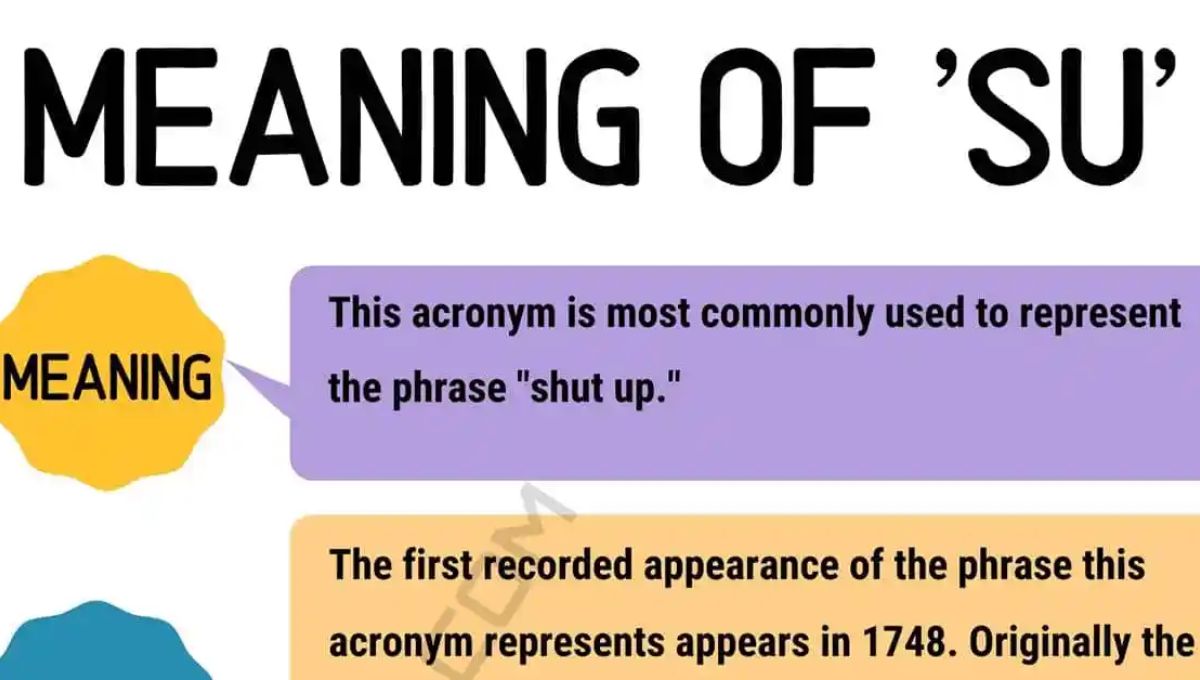
You get a text that just says “su.” No punctuation, no context, nothing. Your brain freezes for a second because you genuinely don’t know if your friend just greeted you or told you off. Sound familiar?
That two-letter mystery is exactly why so many people search for SU meaning in text every single day. It shows up in WhatsApp chats, Instagram DMs, gaming lobbies, and group texts at 1 a.m., and its meaning bends depending on who’s typing it and why.
This guide breaks down every definition, shows you real examples, and teaches you how to read the tone so you’re never left guessing again.
What Does SU Mean in Text?
At its simplest, SU is a text abbreviation that carries more than one meaning, and that’s exactly what trips people up.
Depending on the conversation, SU can mean “shut up,” “sup” (short for “what’s up”), or “swipe up” on social media. The letters never change, but the intent absolutely does.
Think of SU like a word with three different jobs.
A hammer can drive a nail or pry one out, and which job it’s doing depends entirely on how you’re holding it. Text slang works the same way: the letters stay fixed, but the situation tells you what they’re actually doing.
Definition of SU
SU is a modern texting abbreviation used across messaging apps, social platforms, and online chats. In the broadest sense, it’s shorthand people use to save time and keystrokes while keeping a conversation moving.
It’s informal by nature, which means you’ll see it far more often between friends than in a work email.
Here’s the quick breakdown:
- Primary use: “Shut up,” said playfully or seriously depending on tone
- Secondary use: “Sup,” a casual greeting that means “what’s up”
- Platform-specific use: “Swipe up,” an Instagram and Snapchat instruction tied to Stories
What Does SU Stand For?
So, what does SU stand for exactly? It depends on where you spot it.
| Context | What SU Stands For |
| Casual chat between friends | Shut Up |
| Opening line in a message | Sup / What’s Up |
| Instagram or Snapchat Story caption | Swipe Up |
| Gaming chat | Usually Shut Up, sometimes Sup |
Origin & Background
Text abbreviations like SU didn’t appear out of thin air. They grew out of necessity. Back in the early days of SMS, messages were capped at 160 characters, so shaving letters off common phrases wasn’t just trendy, it was practical.
“Shut up” became “SU” in early chatrooms and flip-phone texting because every character counted.
As instant messaging matured through AIM, MSN Messenger, and eventually smartphones, that same abbreviation carried over. Then social media added a twist.
When Instagram introduced the swipe-up link feature for Stories around 2017, content creators needed a short, punchy call to action, and “SU” fit perfectly on a screen with limited caption space.
Meanwhile, younger users started blending SU with “sup,” blurring the line even further. The result? One abbreviation, three lives, and a whole lot of room for confusion if you don’t know the context.
Read This Blog…What Does WH Mean in Text Messages Today? The Complete 2026 Guide 🤔💬
Meanings Across Platforms / Similar Terms & Alternatives
Different apps tend to favor different meanings, so knowing where you’re chatting helps you decode the message faster.
| Term | Meaning | Platform / Usage |
| SU | Shut up / Sup / Swipe up | WhatsApp, Instagram, texting |
| WU | What’s up | Texting, informal chat |
| SUP | What’s up | Texting, casual greeting |
| HMU | Hit me up | Texting, invites |
| YO | Hey / Hello | Very casual greeting |
| GM | Good morning | Polite, informal |
| HBU | How about you | Follow-up question |
| STFU | Shut the f*** up | Aggressive, strong reaction |
How to Respond to SU
Not sure how to reply? Match the energy you’re receiving. A playful SU deserves a playful comeback, while a sharper one might call for a calmer response.
- If it feels friendly: “Haha okay okay, my bad”
- If it feels teasing: “Make me”
- If it feels like a greeting: “Not much, you?”
- If it feels serious: “Got it, sorry about that”
Differences From Similar Words
SU isn’t the only shorthand doing double duty in your texts, but it stands apart from its cousins in a few clear ways.
Unlike “STFU,” which almost always signals genuine frustration, SU can go either way. It softens easily with an emoji or a laughing “haha” tacked on.
Compare that to “GM” or “HBU,” which are specific and single-purpose. GM only means good morning. HBU only asks a follow-up question. SU carries ambiguity that those terms simply don’t have, and that ambiguity is exactly why it needs context to make sense.
Read This Blog…25 Other Ways to Say “Stay Tuned” (With Examples)
How SU Is Used in Text Messages
In day-to-day texting, SU tends to show up in a few predictable spots:
- Opening a conversation after a while apart
- Reacting to something surprising or embarrassing
- Teasing a friend mid-conversation
- Wrapping up a exchange with a lighthearted jab
Examples of SU in Sentences
Here’s how SU looks dropped into real, everyday sentences:
- SU, you’re totally lying right now.
- Just saw your post, su?
- SU! Long time no talk.
- Hey, su? What have you been up to?
- SU, did you actually watch the game last night?
- Morning! Su today?
- SU, I can’t believe you said that.
- SU, any plans this weekend?
- SU bro, that’s wild.
- SU, I just got some huge news.
SU Examples in Chat Conversations

Real conversations make the meaning click faster than any definition can.
WhatsApp Chat
Person A: I just found your old pictures from 2015 Person B: su, don’t expose me like that
Instagram DM
Person A: Just posted a new reel Person B: say less, I’ll su right now
TikTok Comments
User 1: This is so fake honestly User 2: su bro, it’s just content
Text Message
Person A: Guess who I ran into today Person B: suuu tell me right now
Each of these examples uses SU a little differently, which is the whole point. Context does the heavy lifting every time.
When Should You Use SU?
SU fits naturally into low-stakes, informal conversations. Good moments to use it include:
- Chatting with close friends or people you text regularly
- Casual check-ins that don’t need a formal greeting
- Reacting to something funny, surprising, or mildly annoying
- Group chats where the tone is already relaxed
When Not to Use SU?
There are plenty of situations where SU just doesn’t belong, and using it in the wrong spot can genuinely hurt how you come across.
- Professional emails or work Slack messages
- Texting someone you’ve just met
- Academic or formal writing of any kind
- Conversations with older relatives or authority figures who might read it literally
- Serious or sensitive discussions where tone really matters
Emotional & Psychological Meaning
Here’s something most guides skip entirely: SU isn’t just a word swap, it’s an emotional shortcut. When someone drops SU into a text, they’re often signaling closeness rather than distance.
You don’t casually tell a stranger to shut up. You only say it, half-joking, to someone comfortable enough to laugh it off.
What it can express:
- Playful teasing between close friends
- Mild annoyance without real anger behind it
- Genuine surprise or disbelief
- Casual curiosity, especially in its “sup” form
A relatable scenario:
Picture this: you’re joking around with your best friend, and they bring up something embarrassing you did last summer. You fire back with “su 😂.” You’re not actually mad. You’re laughing while also telling them to knock it off, and that mix of humor and mock-annoyance is exactly why SU works so well in close relationships. It says a lot in two letters and one emoji.
Usage in Different Contexts
Social Media
On platforms like Instagram and Snapchat, SU frequently means “swipe up,” especially in captions tied to Stories with a link attached. You’ll see it phrased like “New post is live, su!” underneath a Story graphic.
Friends & Relationships
Among friends, SU leans playful more often than not. It’s teasing, sometimes sarcastic, and almost always affectionate underneath the surface.
Work / Professional Settings
This one’s simple: don’t use it. SU rarely, if ever, belongs in professional communication. It can come across as immature or even disrespectful, no matter how casual your workplace culture is.
Casual vs Serious Tone
Casual SU feels light, funny, and relaxed, usually paired with an emoji or exclamation point. Serious SU tends to show up flat, with no punctuation softening it, and can land harsher than intended.
Common Misunderstandings
1. Assuming it’s always rude
Plenty of people hear “shut up” and immediately think insult. Among friends, it’s rarely meant that way.
2. Confusing meanings
Someone unfamiliar with the term might not realize SU could mean “sup” or “swipe up” instead of “shut up,” which leads to some genuinely funny mix-ups.
3. Tone misreading
Without emojis, punctuation, or prior context, SU can read far more aggressive over text than it would if spoken out loud.
4. Literal interpretation
Some people, especially those less familiar with texting slang, take “shut up” at total face value and get offended when none was intended.
Comparison Table
| Expression | Meaning | Tone | Usage Context |
| SU | Shut up / Swipe up / Sup | Playful to rude | Casual chats, social media |
| STFU | Shut the f*** up | Aggressive | Arguments, strong reactions |
| Sup | What’s up | Friendly | Greetings |
| Chill | Relax | Calm or dismissive | General conversation |
| Ignore | Not responding | Neutral | General behavior |
Key Insight
SU occupies a strange middle ground. It can swing from warm and playful to blunt and dismissive depending entirely on tone, and that flexibility is precisely why it’s both popular and, at times, misunderstood.
Variations / Types
Texting slang rarely stays static, and SU has picked up plenty of spinoffs over time:
- SU – Standard playful teasing
- SU bro – Friendly, casual tone
- SU pls – Softer, almost pleading
- SU rn – Urgent or emotionally charged
- SU 😂 – Shock mixed with humor
- SU?? – Confused or questioning
- SUU – Extended for emphasis
- SU fr – “Shut up, for real?” disbelief
- SU haha – Lighthearted joke
- SU man – Casual frustration
How to Respond When Someone Uses It
Casual Replies
- “Okay okay, my bad”
- “Nah, you started it”
- “Fine, fine”
Funny Replies
- “I refuse 😂”
- “Nope, just getting started”
- “Say please first”
Mature Replies
- “Alright, I’ll drop it”
- “Fair point, I get it”
Respectful Replies
- “Got it, sorry about that”
- “Didn’t mean to annoy you”
Whatever you choose, match the tone of the message you received. Responding seriously to a joking SU tends to kill the mood fast.
Regional & Cultural Usage
Western Culture
Among American and broader Western audiences, SU skews casual and is common in Gen Z texting slang. It’s rarely taken as a serious insult in this context.
Asian Culture
In many Asian messaging cultures, SU shows up less often in formal settings and can feel ruder if the recipient isn’t already familiar with Western texting slang.
Middle Eastern Culture
Usage here depends heavily on the closeness of the relationship. Between close friends, it’s often used jokingly; with acquaintances, it can land poorly.
Global Internet Usage
Thanks to global platforms like Instagram, TikTok, and WhatsApp, SU has spread well beyond any single region, though its exact meaning still shifts based on local texting norms.
Generational Differences
Gen Z tends to use SU freely and creatively, layering it with emojis and variants like “su fr” or “suu.” Millennials, by comparison, tend to use it more cautiously and often avoid it altogether in ambiguous situations.
Is It Safe for Kids?
SU itself isn’t inherently harmful. In friendly, everyday chats, it’s harmless texting slang, nothing more. That said, context still matters.
In an argument or a tense exchange, it can encourage a more dismissive or rude tone than a kid might intend. Parents and educators are better off focusing on how the term gets used rather than banning the word outright, since the letters themselves carry no real risk.
Conclusion
Understanding SU meaning in text really comes down to one skill: reading between the lines. It’s not a fixed definition you can memorize once and forget.
It shifts with tone, platform, and relationship, swinging from a playful jab between best friends to a straightforward Instagram call to action.
Pay attention to punctuation, emojis, and the conversation surrounding it, and SU stops being confusing fast. Once you’ve got the hang of it, you’ll never freeze up over a two-letter text again.
FAQs
Is “SU” rude?
It can sound blunt out of context, but among friends, it’s usually playful rather than genuinely rude.
Can I use “SU” in formal chats?
It’s best kept out of professional or formal communication entirely.
Why do people use “SU” instead of full words?
It’s faster to type and fits the fast-paced, informal style of modern texting.
How do I know what it means?
Look at the context, the platform, your relationship with the sender, and any emojis attached.
Is “SU” the same as “STFU”?
STFU is far more aggressive and direct; SU is softer and more flexible in tone.
Is SU formal or informal?
Strictly informal. Save it for casual conversations only.
Can I use SU in professional emails?
Stick to proper greetings and phrasing in professional or formal writing.
What are alternatives to SU?
Common alternatives include WU, SUP, YO, HBU, and GM, depending on what you’re trying to say.
Is SU the same as SUP?
They overlap. SUP almost always means “what’s up,” while SU can mean that or something sharper.
Can SU be used in social media comments?
It works well in casual comments or DMs among friends and followers.
Does SU have a negative meaning?
It can, but it’s usually neutral to playful rather than genuinely negative.
Can SU be used in group chats?
Absolutely. It’s common shorthand for greeting or teasing multiple people at once.
How old is the term SU?
It traces back to early SMS and chatroom slang from the 1990s and early 2000s.
Can SU be used with emojis?
Yes, and doing so usually softens the tone and makes the intent clearer.
Is SU commonly understood worldwide?
Mostly among English-speaking, internet-savvy audiences, particularly younger users.
Can SU replace “Hello”?
In casual settings, yes, though it’s less formal than a standard greeting.
Is SU gender-specific?
It’s neutral and used the same way regardless of who’s texting.
Can I use SU in texting strangers?
Only if the conversation is already casual; otherwise, stick with formal language.
Is SU used in gaming chats?
Gamers use it often to check in with teammates or react quickly mid-match.
How do I remember SU?
Think of it as a fast lane word: three possible meanings, one quick read of the context, and
you’re set.