You’re scrolling through Instagram on a random Tuesday night, half-watching TV, half-thumbing through stories. Then it hits you: three different friends have posted “SFS anyone? 😄” within the same hour. You pause. You reread it. You still have no idea what it means, and honestly, you’re a little embarrassed to ask.
Don’t worry, you’re not behind on some secret internet exam. SFS is one of those bite-sized acronyms that spread across social media so fast, half the people using it couldn’t explain it if you asked them directly.
This guide breaks down exactly what SFS means, where you’ll run into it, how to use it the right way, and what to do when someone drops it in your DMs. By the end, you’ll not only know the SFS meaning in text, you’ll know how to use it like you’ve been doing it for years.
Quick Answer:
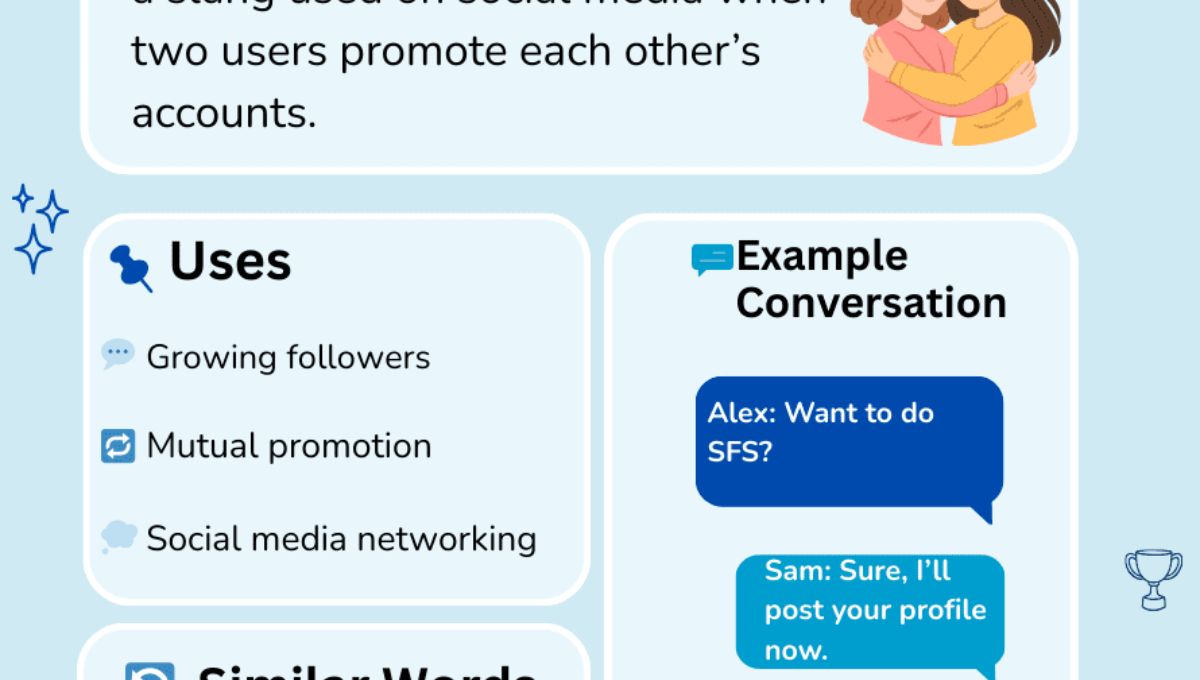
SFS stands for “Shoutout For Shoutout.” It’s a mutual promotion move where one person promotes another’s profile or content, and the other person returns the favor.
What Does SFS Mean in Text?

At its core, SFS meaning in text boils down to one simple idea: reciprocity. Someone gives you a shoutout, a mention, a repost, and you give one right back. Think of it as social media’s version of “you scratch my back, I’ll scratch yours.”
So, what does SFS mean, exactly, when your friend texts it to you out of nowhere? In most cases, especially in casual texting or DMs, SFS stands for “Shoutout For Shoutout.” Someone’s asking you to promote them (tag them, mention them, repost their content), and they’ll do the same for you in return.
Here’s the thing about the SFS acronym: it didn’t come out of nowhere. It grew directly out of influencer culture, back when creators realized that promoting each other worked better than shouting into the void alone.
A smaller account tags a bigger one, or two similarly-sized accounts agree to cross-promote, and suddenly both audiences overlap and grow. That strategy caught on, got shortened into a hashtag, and turned into the SFS slang you see everywhere today.
In plain terms:
- SFS full form: Shoutout For Shoutout
- SFS abbreviation: Used mainly on Instagram, TikTok, and in general texting
- SFS definition: A mutual agreement to promote each other’s content or profile
A quick text exchange might look like this:
Friend 1: “Hey, want to do an SFS? I’ll post you on my story if you post me on yours.” Friend 2: “Yeah, let’s do it! Send me your best pic.”
Nothing complicated. Just two people agreeing to help each other out.
Where Is SFS Commonly Used?
Once you know the SFS texting meaning, you’ll start noticing it everywhere. It’s not confined to one corner of the internet, either. This little four-letter combo travels across nearly every major platform, though the tone shifts slightly depending on where you see it.
Here’s a rundown of where SFS in texting and SFS in messages typically shows up:
- 📱 SFS on Instagram — captions, stories, comments, and DMs
- 🎵 SFS on TikTok — duet requests, comment sections, and collab shoutouts
- 🐦 SFS on Twitter (SFS on X) — tweet threads promoting mutuals
- 👻 SFS on Snapchat — story reposts and group chats (with a slightly different meaning, more on that below)
- 💬 SFS on WhatsApp — occasionally used in group chats when discussing content sharing
- 🎮 Gaming chats — streamers and content creators asking for cross-promotion on Twitch or YouTube
What Does SFS Mean on Instagram?
Instagram is really where SFS built its home. Since the platform is so visual, cross-promotion through stories and posts became second nature to creators trying to build an audience fast.
On Instagram specifically, SFS meaning stays the same as texting: Shoutout For Shoutout. However, the mechanics look a little different once you factor in stories, tagging, and the algorithm.
Here’s how it typically plays out:
- A user posts a story or caption tagging another account, along with #SFS.
- The tagged account either reposts that story to their own followers, or creates a similar post shouting out the original user.
- Both accounts benefit from new eyes, new followers, and better reach thanks to the algorithm rewarding engagement.
SFS on Instagram Stories vs. Feed Posts
There’s a meaningful difference here worth knowing:
| Format | Lifespan | Best For |
| Instagram Stories | 24 hours | Quick, low-commitment shoutouts |
| Feed Posts | Permanent (until deleted) | Bigger collaborations, brand partnerships |
Example SFS Captions on Instagram
If you’re curious what this actually looks like in the wild, here are a few realistic caption examples:
- “#SFS with my favorite travel accounts 🌍✈️”
- “Doing an SFS today, drop your handle below! 👇”
- “Shoutout to @username for the amazing content, check them out! #SFS”
- “SFS Sunday — tag your fave creators!”
Why Do Instagram Users Say “SFS”?
You might be wondering why an entire promotion culture built itself around a four-letter acronym. The honest answer comes down to trust and efficiency.
When a friend or someone you follow recommends an account, that recommendation carries more weight than a random ad ever could. Influencer marketing figured this out a long time ago: audiences trust peer endorsements far more than paid promotions.
That’s exactly why cross promotion through SFS works so well. It doesn’t feel like advertising, it feels like a friend saying, “Hey, you’d like this.”
There’s also the algorithm angle. Instagram rewards audience interaction and user engagement. Every tag, repost, and comment signals activity, which nudges the algorithm to show your content to more people.
So when two accounts do an SFS, they’re not just borrowing each other’s followers, they’re actively boosting their organic reach through genuine engagement.
And for smaller accounts, SFS opens a door that would otherwise stay shut. Getting noticed by a bigger creator through a simple shoutout exchange can lead to real audience growth, without spending a dollar on ads. It’s networking on social media in its purest form.
How and When to Use SFS on Instagram?
Timing and targeting make all the difference between an SFS that actually works and one that falls flat. Here’s how to do it right.
Focus on the right accounts.
Don’t randomly tag huge, unrelated accounts hoping for a miracle. If you run a fitness page, look for other fitness or wellness creators with a similar-sized following. Overlapping audiences convert far better than random ones.
Reciprocate the exchange.
SFS only works because both sides give something of value. If someone shouts you out, return the favor. Ghosting an SFS partner burns bridges fast in creator circles.
Add relevant hashtags.
Pairing #SFS with niche-specific tags (like #photography, #fitness, or #smallbusiness) helps the right audience actually discover the post.
Be selective.
Not every post deserves an SFS tag. Overusing it makes your account look desperate rather than intentional, and plenty of users consider spammy SFS posts annoying clickbait.
Quick checklist before you post an SFS request:
- ✅ Does your niche overlap with theirs?
- ✅ Are you ready to actually repost or shout them out in return?
- ✅ Is your content genuinely worth sharing?
- ✅ Have you added a relevant hashtag beyond just #SFS?
Examples of SFS in Conversation
Seeing SFS used in real conversations makes the concept click faster than any definition could. Here are a handful of realistic exchanges across different contexts.
Example 1 — Casual friend chat:
A: “SFS anyone? 😄” B: “Sure! Drop your profile, I’ll give you a story shoutout!”
Example 2 — Influencer collaboration:
A: “Let’s do an SFS later tonight, I’ll tag you in my next post.” B: “Sounds good! I’ll send over my best content.”
Example 3 — Small business networking:
A: “Want to do an SFS between our shops? Might help both of us grow.” B: “Absolutely, let’s set it up for this weekend.”
Example 4 — Gaming/streaming community:
A: “SFS on Twitch? I’ll shout out your channel during my next stream.” B: “Deal, I’ll do the same for you.”
Example 5 — TikTok collab:
A: “SFS time! Who wants in on this duet chain?” B: “Me! Let’s help each other out.”
Notice the pattern: every single one involves an offer, and a return offer. That reciprocity is the entire engine behind SFS promotion.
When to Use and When Not to Use SFS
Like most slang, SFS fits perfectly in some contexts and looks completely out of place in others.
✅ When to Use SFS
- Casual conversations with friends on social media
- Promoting or supporting a friend’s small business or account
- Growing your following through genuine mutual promotion
- Participating in community challenges or collaboration posts
- Networking with other content creators in your niche
❌ When Not to Use SFS
- Formal emails or professional communication
- Urgent or serious conversations (nobody wants “SFS” during a crisis)
- Private messages with strangers you don’t trust
- Situations where promotion might come across as pushy or out of place
- Client-facing business communication
Here’s a side-by-side comparison to make the contrast obvious:
| Context | Example Phrase | Why It Works |
|---|---|---|
| Friend Chat | “SFS? Drop your handle 😄” | Casual, friendly, low stakes |
| Work Chat | “Let me know if you need anything.” | Polite, professional |
| “Please review this at your convenience.” | Formal, clear | |
| Social Media | “SFS anyone? Tag your faves!” | Engagement-focused, community-driven |
Similar Slang Words or Alternatives
SFS belongs to a whole family of shorthand terms that dominate internet slang and social media slang today. Knowing how they compare helps you avoid mixing them up mid-conversation.
SFS vs Other Popular Instagram Slangs
1. SFS (Shoutout For Shoutout)
Meaning: Two users agree to promote each other’s accounts to grow their following.
Example:
“I’ll do an SFS with you if you shout me out on your story!”
2. F4F (Follow For Follow)
Meaning: A mutual agreement where one person follows another expecting a follow back.
Example:
“F4F? I followed you, now follow me back!”
3. L4L (Like For Like)
Meaning: An exchange where users like each other’s posts.
Example:
“L4L? I’ll like your latest post if you like mine!”
4. DM (Direct Message)
Meaning: A private message sent through a platform’s messaging feature.
Example:
“Hit me up in my DMs later!”
5. BFF (Best Friends Forever)
Meaning: A term for someone you consider extremely close, often used casually online.
Example:
“Thanks for being my BFF and supporting me all the way!”
6. ICYMI (In Case You Missed It)
Meaning: Used when reposting or highlighting something a follower might have missed.
Example:
“ICYMI, here’s the update on our latest collab!”
7. TBH (To Be Honest)
Meaning: Used to give an honest opinion or share genuine feedback.
Example:
“TBH, your recent post is amazing, keep it up!”
8. TBT (Throwback Thursday)
Meaning: A weekly tradition of posting old photos, typically on Thursdays.
Example:
“TBT to last summer when we went to the beach!”
9. SMH (Shaking My Head)
Meaning: Expresses disbelief, frustration, or disappointment.
Example:
“SMH at how some people treat others online.”
10. OOTD (Outfit of The Day)
Meaning: A post showcasing someone’s daily outfit.
Example:
“Here’s my OOTD, let me know what you think!”
While each of these terms serves its own purpose, SFS stands apart because it’s specifically about shoutout promotion and content promotion, not likes, follows, or casual commentary. If F4F and L4L are the appetizers of social media reciprocity, SFS is the main course.
Steps: How SFS Works Across Platforms
Different platforms handle SFS slightly differently. Here’s a breakdown of the meaning and mechanics on each one.
What Does SFS Mean on Snapchat?
On Snapchat, SFS technically stands for “Snap For Snap” rather than “Shoutout For Shoutout.” Snapchat users, especially those chasing visibility, post a snap and caption it #SFS, asking followers to repost it as their own story. In exchange, the original poster promotes the follower’s content back.
- A user might tag you in an #SFS post to get your attention, especially if you’re a fellow creator.
- If you respond by reposting, they’ll typically promote your profile in return, helping you gain more visibility too.
What Does SFS Mean on Instagram?
As covered above, SFS on Instagram means “Shoutout For Shoutout” or occasionally “Spam For Spam.” The mechanics stay the same as Snapchat’s version, just adapted for posts, stories, and captions instead of snaps. A user captions their post with #SFS, hoping followers will reshare it, and cross-promotion follows.
How to Use SFS on Snapchat and Instagram
Regardless of platform, the general process looks like this:
- Post your content with the caption #SFS to signal you’re open to promotion.
- Add relevant hashtags alongside SFS (like #photography or #smallbusiness) to reach the right audience.
- Tag specific users if you want to get their attention directly.
- Be selective about when you use it. Overusing #SFS on every single post reads as spammy rather than intentional.
Responding to SFS on Snapchat and Instagram
If someone tags you in an SFS post and you want to help them out, simply repost their content to your own story or feed. They’ll typically return the favor, and both of you walk away with a little audience growth.
That said, you’re never obligated to respond. Ignoring an #SFS tag is completely acceptable; it’s entirely up to you whether you want to participate.
Other Possible Meanings of SFS
Context matters more than you’d think with this acronym. Depending on where you see it, SFS could mean something completely different:
- So Freaking Stressed — used in texts from a friend venting about a stressful day (“Got a test tomorrow and SFS about it.”)
- Seriously Funny Sh*t — used casually to react to something hilarious
- Safe For School — occasionally used to indicate content is appropriate for a school setting
- Single For Sale — a joking, sarcastic phrase used in some social circles
- Share For Share / Spam For Spam — alternative phrasing for the same shoutout-exchange concept on non–Snapchat platforms
FAQs
Q1: What does SFS mean in a text from a girl or guy?
It almost always means “Shoutout For Shoutout,” a friendly request for mutual promotion, unless the context suggests stress or humor instead.
Q2: Is SFS the same as a shoutout?
A shoutout is a one-way mention, while SFS specifically implies a mutual, two-way exchange.
Q3: Does doing an SFS guarantee more followers?
It boosts visibility and engagement, but actual follower growth depends on content quality and audience overlap.
Q4: Can businesses use SFS too?
Small businesses frequently use SFS to cross-promote with other brands and reach new, relevant audiences.
Q5: What’s the difference between SFS and F4F?
SFS focuses on promoting content or profiles through shoutouts, while F4F is simply about exchanging follows with no content promotion involved.
Conclusion
At the end of the day, SFS boils down to one simple, human idea: help someone out, and they’ll help you out too. Whether you run into it on Instagram, Snapchat, TikTok, or in a random text from a friend, the spirit behind it stays consistent. It’s mutual support, community building, and a little bit of hustle, all wrapped into a four-letter acronym.
Next time someone drops “SFS anyone?” in your comments, you won’t have to Google it. You’ll know exactly what they mean, how to respond, and whether it’s actually worth your time. And honestly? That’s one less mystery cluttering up your feed.












1 thought on “What Does SFS Mean in Text? Your Complete 2026 Guide to Social Media Tips(2026)”