Someone just texted “I really fw you” and now you’re staring at your phone, wondering if that’s a compliment or a red flag. Don’t worry, you’re not the only one who’s paused mid-scroll trying to decode this one.
FW meaning in text trips up a lot of people because it looks like it could mean five different things depending on where you spot it.
This guide breaks it all down: what it stands for, how people actually use it, when it’s a compliment, and when you should probably steer clear of typing it yourself.
What Does FW Mean in Text and Chat?
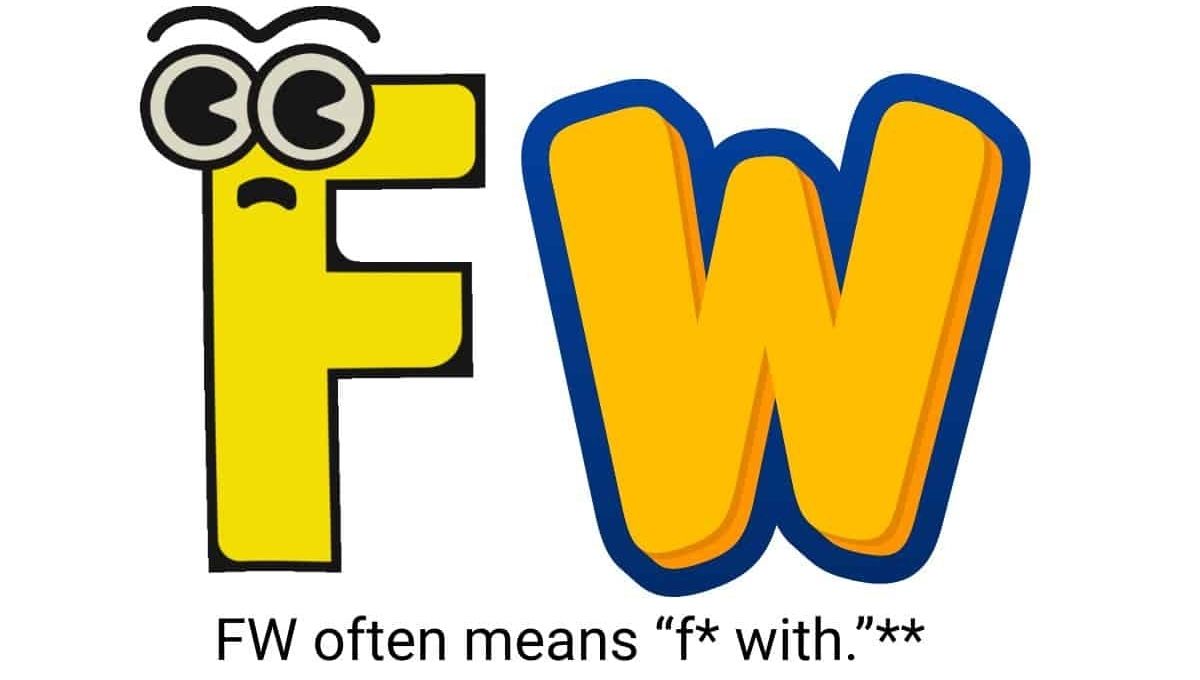
In texting and social media, FW usually means “f*ck with.” That sounds a lot harsher than it actually is in practice.
People use FW to say they like something, support someone, or feel a genuine connection with a person or idea. It’s less about conflict and more about approval.
Here’s a simple way to think about it: if someone says “I fw this song,” they’re basically saying they’re into it. Swap “fw” for “vibe with” or “mess with” (in the good sense), and you’ll land pretty close to the real meaning.
The exact meaning of FW depends heavily on context, though, which is exactly why so many people end up confused the first time they see it.
You’ll run into FW constantly across text messages, DMs, and comment sections. It’s become one of those texting slang terms that spread from urban slang into mainstream digital communication, and it shows zero signs of slowing down.
Read this Blog…25 Other Ways to Say “Past is Past” (With Examples)
Full Form, Stands For & Short Meaning of FW
FW stands for “f*ck with.” That’s the short answer. But since FW doubles as shorthand for a handful of unrelated terms depending on context, it helps to separate the common meaning from the rarer ones.
Most Common Meaning
| Abbreviation | Meaning |
| FW | F*** With |
Other Meanings
| Abbreviation | Meaning |
| FW | Forward (email usage) |
| FW | Framework |
| FW | Firmware |
| FW | Fireworks (occasionally) |
| FW | Fashion Week |
What Does FW Mean in Gen Z Slang?
Gen Z didn’t invent FW, but they’ve absolutely made it a permanent fixture of everyday texting. Ask any teenager or young adult what FW means, and they’ll answer without missing a beat.
What’s interesting is how little the meaning has shifted over time. Unlike slang that mutates every six months, FW meaning in Gen Z circles has stayed remarkably close to its roots in hip-hop and urban slang.
What has changed is the styling — younger users pair it with emojis, stretch it out for emphasis (“I FWWWW this”), or drop it in all caps for extra impact. The word stayed the same. The delivery got louder.
Gen Alpha and younger millennials have picked it up too, which says something about its staying power.
Slang that survives across multiple generational waves online usually earns that longevity because it’s short, flexible, and easy to type without overthinking it.
What Does “I FW You” Mean?
When someone texts “I fw you,” they’re telling you they like you, respect you, or genuinely enjoy your company. It’s a warm statement, not a confrontational one, despite how the underlying phrase sounds.
Context shapes the intensity, though. A friend might say it casually to mean “you’re cool, I like hanging out with you.” A romantic interest might say it with a flirtier undertone, hinting at attraction rather than plain friendship.
Either way, “I fw you” ranks as one of the more genuine compliments in modern texting slang, so if someone sends it your way, take it as a good sign.
What Does “I Don’t FW You” Mean?
Flip the script, and “I don’t fw you” delivers the opposite message entirely: disinterest, distrust, or flat-out dislike. Adding “don’t” in front of FW is one of the fastest ways to shut something down in casual conversation.
This phrase shows up in a few common situations:
- Ending a friendship or association (“I don’t fw people who flake constantly”)
- Rejecting an idea or plan (“I don’t fw that idea, honestly”)
- Expressing personal boundaries (“I don’t fw drama”)
What Does “I FW This” Mean?
“I fw this” almost always points to approval of a thing rather than a person — a song, an outfit, a trend, a meal, a plan. It’s the texting equivalent of a thumbs-up, minus the actual thumbs-up emoji.
Example:
“I don’t usually like Italian food, but I really fw this pasta tonight.”
That sentence tells you everything about how FW functions grammatically. It slots in exactly where “like” or “enjoy” would go, just with more personality attached.
Origin, History & First Known Use of FW
FW traces its roots back to hip-hop and urban slang, where the full phrase “f* with”** carried connotations of approval, loyalty, and association long before texting existed.
Musicians and artists used it in lyrics and interviews to describe who they trusted, respected, or associated with.
As texting exploded in the early 2000s, people began compressing longer slang phrases into abbreviations for speed. Terms like TBH, SMH, IMO, FR, and NGL all emerged from that same shortening trend, and FW followed right along with them.
Social media then took over as the primary spreading mechanism, carrying FW far beyond its original hip-hop context and into mainstream texting culture across the country.
Today, younger users type “fw” almost automatically, often without consciously thinking about its origin at all.
Is FW Positive or Negative?
FW itself sits neutral. It’s the words around it that tip the scale one way or the other.
| Version | Tone |
| “I fw that” | Positive — approval, liking something |
| “I really fw you” | Positive — affection, respect |
| “I don’t fw that” | Negative — dislike, disapproval |
| “I’m gonna fw them” | Negative-leaning — annoyance, mild threat |
How Is FW Used in Text Messages?
FW shows up in texting in a handful of consistent, predictable patterns. Once you learn to spot them, decoding any FW text becomes second nature.
- As approval: “I fw that outfit.”
- As friendship confirmation: “Do you still fw him?”
- As trust: “That’s someone I really fw.”
- As disapproval: “I don’t fw that.”
- As mild threat or annoyance: “I’m gonna fw her life if she keeps this up.”
FW Examples in Text and Chat
Real conversations make this concept click a lot faster than definitions alone.
Between friends:
Friend 1: “Have you heard the new album?”
Friend 2: “Yeah, I fw it hard.”
In a group chat:
Friend 1: “New coffee spot opened downtown”
Friend 2: “I fw this coffee shop already ☕”
On social media:
Instagram comment:
“FW this vibe 🔥”
Expressing dislike:
“I cannot fw people who don’t text back.”
Flirty context:
“Your new hairstyle looks cute. I really fw that look on you.”
These examples cover the emotional range FW can carry — casual, enthusiastic, dismissive, or flirtatious — all with the same three letters doing different jobs depending on tone.
How to Reply to “FW”?
Getting an FW text doesn’t require overthinking. Match the energy, and you’re set.
Casual replies:
- “Same here.”
- “Yeah, it’s pretty good.”
- “I like it too.”
Friendly replies:
- “Glad you fw it!”
- “I knew you’d like it.”
- “That’s awesome.”
Funny replies:
- “Your taste is finally improving 😂”
- “Welcome to the fan club.”
- “Took you long enough.”
Formal-leaning replies (when someone’s genuinely complimenting you):
- “I really appreciate that.”
- “That means a lot, thank you.”
Does FW Mean “Forward”?
Yes, but only in a completely different context. In emails, FW almost always means “forward.” You’ll see it stamped at the front of a subject line whenever a message gets passed along from one person to another — something like
“FW: Meeting Schedule” or “FW: Q3 Report.”
This is where a lot of confusion creeps in. Someone unfamiliar with texting slang sees “FW” in a work email and assumes it carries the same meaning as it does on Instagram. It doesn’t. Email FW and texting FW are two completely unrelated abbreviations that just happen to share the same three letters.
FW Meaning in Email and Work
In professional settings, FW meaning shifts entirely toward “forward” or “forwarding.” A few standard examples:
- “Can you FW me that history assignment?” → Send me the message containing it.
- “I’m going to FW you the email.” → I’ll pass along a copy.
- “FW: Project Update” → This email got forwarded from someone else.
Business communication occasionally borrows this shorthand too, using FW to indicate forwarded documents or internal correspondence.
If you’re emailing coworkers or clients, this is the only meaning of FW you need to worry about — the slang version has no place there.
FW Meaning on Snapchat, TikTok, Instagram, and WhatsApp
The core meaning of FW stays consistent across platforms, but the flavor shifts slightly depending on where you spot it.
| Platform | Typical Meaning |
| Snapchat | Direct chats, often asking about friendship or association (“You still fw him?”) |
| Comments and captions expressing approval (“FW this vibe 🔥”) | |
| TikTok | Reacting to trends, sounds, or videos (“I fw this trend”) |
| Casual approval between friends in group or 1-on-1 chats |
Is FW Offensive or a Bad Word?
Not really, and this surprises a lot of people once they learn what FW technically stands for.
Yes, the full phrase contains a curse word. But in practice, FW functions as a softened, abbreviated stand-in that rarely reads as offensive in casual conversation.
As Faraz puts it, the slang is neutral — someone can say “I FW that” to praise something and “I’m not fw that” to express disinterest, and neither carries an inherently negative charge.
The abbreviation strips away most of the intensity the full phrase would carry if spelled out.
That said, context still matters. Using it around people unfamiliar with the slang, or in situations calling for extra politeness, might raise an eyebrow. It’s mild, but it’s not invisible.
Is FW Appropriate at Work?
Generally, no — save it for casual conversations outside the office. Even though FW rarely comes across as rude among friends, it’s still rooted in profanity, and that’s enough reason to avoid it in professional communication.
A quick rule of thumb:
if you wouldn’t say the full phrase out loud in a work meeting, don’t type the abbreviation in a work Slack channel either. It’s not about the letters — it’s about what they represent.
FW vs. FWB: What’s the Difference?
These two get mixed up constantly, but they’re not related at all.
| Term | Meaning |
| FW | “F*ck with” — liking, supporting, or associating with someone/something |
| FWB | “Friends with benefits” — a specific type of casual romantic/physical relationship |
FW vs. FR: What’s the Difference?
Another easy mix-up, especially in fast-typed messages.
| Term | Meaning | Function |
| FW | F*ck With | Expresses liking or approval |
| FR | For Real | Expresses agreement or emphasis |
How to Understand FW From Context
Context clues make decoding FW pretty painless once you know what to look for.
Steps
- Check the setting. Texting or social media? Probably slang. Email or workplace chat? Probably “forward.”
- Look at what follows FW. A person, song, outfit, or idea usually signals the slang meaning.
- Check for negation. “Don’t fw” flips the meaning to dislike or disinterest.
- Consider the relationship. Friends and romantic interests use FW more casually and warmly than acquaintances would.
- Read the tone of the whole message. Emojis, punctuation, and surrounding words all help confirm which meaning applies.
How People Use FW in Daily Conversations
FW adapts to whatever the conversation calls for. Here’s how it breaks down by function.
To Show Approval
“I FW that outfit.” → Simple, direct compliment about style.
To Show Support
“I FW his content.” → Signals you back someone’s work, creativity, or effort.
To Describe Friendship
“Do you FW him?” → Asking whether someone gets along with or associates with another person.
To Express Trust
“That’s someone I FW.” → A stronger statement, implying respect and reliability, not just casual liking.
Casual Texting Example
Friend 1: “Have you heard the new album?”
Friend 2: “Yeah, I FW it.”
Short, natural, and instantly understood by anyone fluent in texting slang.
Different Meanings of FW in Other Fields
Outside of casual texting, FW picks up entirely unrelated definitions depending on the industry.
FW = Forward. Appears in subject lines to indicate a message got passed along from someone else.
Technology
FW = Firmware — the software permanently embedded in hardware devices, controlling how they function at a basic level.
Software Development
Developers sometimes shorten “framework” to FW in technical documentation or casual dev chats.
Business Communication
Some companies use FW as internal shorthand for forwarded documents, memos, or correspondence chains.
Common Mistakes, Confusions & Wrong Interpretations
FW’s multiple meanings create real room for mix-ups. Here are the most common ones.
Assuming It Always Means Forward
Someone texts “I FW that song,” and it gets misread as “I forwarded that song.” Wrong — in texting slang, this means “I like that song,” not anything related to sharing or sending.
Thinking It’s Negative
Because the underlying phrase contains a curse word, some assume FW automatically carries a negative or hostile tone. In reality, it’s used positively far more often than not.
Misreading the Context
Texting slang and email usage operate as two entirely separate systems. Reading FW in a work email through a texting-slang lens (or vice versa) leads to confusion almost every time.
Is FW Still Popular? Trends & Online Usage
Yes — FW shows no signs of fading from everyday digital communication.
Who Uses It Most?
- Teenagers
- Young adults
- Social media users broadly
- Music fans and creators
- Gaming communities
Where Is It Commonly Seen?
- TikTok comments
- Instagram captions and stories
- Snapchat direct chats
- WhatsApp group messages
- Online forums and gaming communities
Growing or Declining?
FW remains widely used, particularly among younger internet users. New slang terms pop up constantly, but FW has held its ground because it’s short, versatile, and doesn’t require much typing effort — three qualities that tend to help slang survive long-term.
Quick Facts
| Factor | Details |
| Meaning | F*** With |
| Category | Texting slang |
| Tone | Casual |
| Common Platforms | Text, WhatsApp, Instagram, TikTok, Snapchat |
| Popularity | High |
| Formality | Informal |
| Alternative Meanings | Forward, Firmware, Framework, Fashion Week |
FW Meaning — “F*ck With” (Slang)
This is the primary, most widely recognized meaning across texting and social media. It covers everything from liking a song to expressing genuine trust in a friend. If you only remember one definition of FW, this is the one.
FW Meaning — “Fashion Week”
Less common in personal texting, but worth knowing: FW occasionally stands for “Fashion Week” in industry-specific conversations, especially among people following fashion events, an interior designer discussing seasonal trends, or anyone in creative circles referencing upcoming shows. Context makes this meaning obvious fast, since it typically appears alongside brand names, designer references, or event dates rather than casual approval statements.
All FW Meanings Side by Side
Quick Meaning Table
| Context | FW Meaning |
| Texting/Social Media | F*** With |
| Forward | |
| Technology | Firmware |
| Software Development | Framework |
| Fashion Industry | Fashion Week |
| History Discussions | Frederik Willem (de Klerk) |
FW in Online Communities and Dating Apps
Dating apps and online communities lean heavily on FW to signal interest or compatibility. A bio or opening message like “I fw genuine people” tells potential matches exactly what someone values, without needing a paragraph to explain it.
Tips
- Use FW sparingly in a dating bio — one clear line beats several vague ones
- Pay attention to how a match uses FW; it often signals their communication style overall
- If someone says “I fw your profile,” that’s a straightforward compliment, not something to overanalyze
Is FW Appropriate for Professional Communication?
Good
- Casual internal chats between coworkers who know each other well and the company culture supports informal language
- Non-client-facing, low-stakes conversations
Avoid
- Client-facing emails or messages
- Formal reports, presentations, or documentation
- Conversations involving sensitive topics, HR matters, or serious news
- Any communication reflecting on your professionalism to someone outside your immediate circle
Meanings Across Platforms / Similar Terms & Alternatives
| Term | Meaning | Usage |
| FW | F*ck With / Like, support | Casual texting |
| FR | For Real | Agreement/emphasis |
| NGL | Not Gonna Lie | Honest opinion |
| TBH | To Be Honest | Sharing a view |
| IMO | In My Opinion | Giving views |
| SMH | Shaking My Head | Disapproval |
| Bet | Okay, agreed | Acceptance |
| Lowkey | Somewhat, secretly | Casual hedge |
| Vibe | Positive feeling | Social media slang |
When Should You Use FW?
- Casual texts with friends
- Group chats reacting to music, shows, or trends
- Social media comments and captions
- Light flirting or casual DMs with someone you’re interested in
When Not to Use FW?
- Professional emails or workplace communication
- Formal, solemn, or serious conversations
- First-time conversations with people you don’t know well
- Academic writing or official documentation
Similar Words or Alternatives to FW
If FW doesn’t quite fit the moment, plenty of alternatives express similar sentiments:
- “I vibe with this” — casual approval
- “I mess with this” — near-identical meaning, slightly softer
- “I’m into this” — straightforward, widely understood
- “I rock with them” — friendship/loyalty-focused alternative
Conclusion
At its core, FW meaning in text comes down to one simple, versatile phrase: liking, supporting, or trusting something or someone. It sounds a lot harsher spelled out than it actually feels in conversation, and once you know the context clues, decoding it takes about two seconds.
Just remember the split: texting slang says “f*ck with,” while email says “forward.” Get those two straight, and you’ll never second-guess an FW text again — whether it shows up from a friend, a match on a dating app, or a coworker forwarding last week’s meeting notes.
FAQs
Is FW the same as FWD?
Not exactly, though they’re related. FWD is a more formal, fully written-out abbreviation for “forward,” commonly seen in email clients, while FW serves as the shorter, more common version.
Is FW formal or informal?
Informal. FW belongs to casual texting slang and rarely appears in professional or formal writing, aside from its “forward” meaning in emails.
What is the difference between FW and RE?
FW means “forward” in email contexts, while RE means “regarding” or “reply,” typically marking a response to an existing message thread.
Can FW be used in spoken language?
Rarely as “FW” itself, but people do say the full phrase out loud in casual conversation among friends who are comfortable with that language.
Why do people use FW?
It’s short, fast to type, and instantly understood within casual digital communication, making it an efficient way to express approval or connection.
Is FW an acronym or abbreviation?
FW functions as an abbreviation, standing in for a longer phrase rather than forming a new pronounceable word like a true acronym would.
Can FW be misunderstood?
Yes, especially by people unfamiliar with texting slang who might assume it always means “forward” or misread it as inherently negative.
What does FW mean from a girl?
Generally the same core meaning — approval, friendship, or attraction — though tone often leans warmer or more affectionate depending on the relationship.
What does FW mean from a guy?
The meaning stays consistent, though delivery can lean more casual or blunt. Context and relationship history matter more than gender here.
Does FW mean friend with?
No, that’s a common misconception. FW technically stands for “f*ck with,” not “friend with,” even though the two ideas overlap in meaning.
What does FW mean in email?
In email, FW almost always means “forward,” indicating a message was passed along from another sender.
Does FW always mean the same thing?
No. Its meaning shifts entirely based on context — texting slang, email, technology, and fashion all use FW differently.
Is FW popular among Gen Z?
Very much so. Gen Z uses FW constantly across texting and social media, and it remains one of the more consistently used slang terms among younger internet users today.